
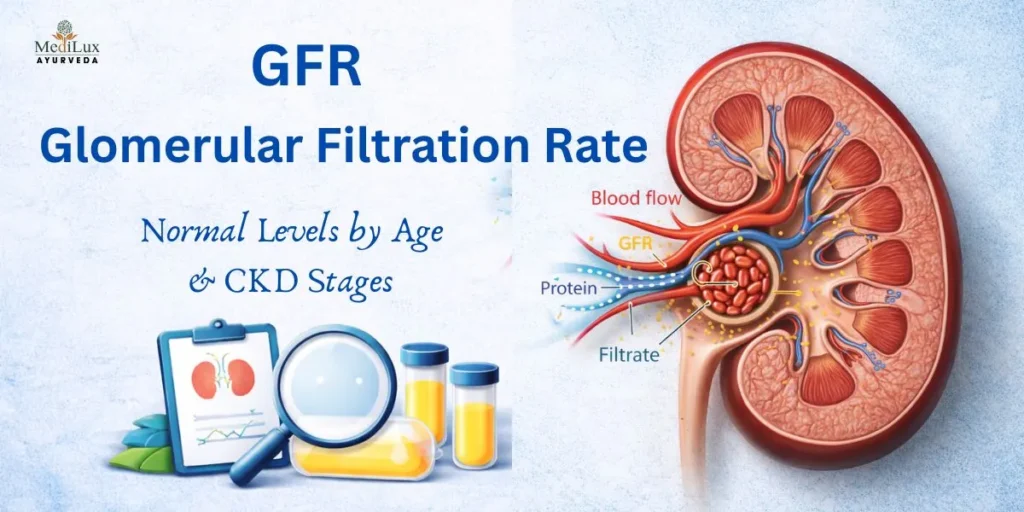
If you’ve ever had routine blood work done, you may have noticed something called GFR or eGFR on your lab report. Maybe the number looked fine. Maybe it was slightly low. Or maybe it left you completely confused.
Don’t worry — you’re not alone.
Glomerular Filtration Rate (GFR) is one of the most important measurements doctors use to evaluate kidney function. Yet most people don’t fully understand what it means until something looks abnormal.
This complete guide explains glomerular filtration rate, normal ranges, low GFR meaning, CKD connection, calculation methods, influencing factors, and improvement options clearly.
Let’s simplify this together.
What Is Glomerular Filtration Rate?
The Glomerular Filtration Rate, commonly referred to as GFR, is used to quantify the overall filtering performance of your kidneys in ridding your body’s blood supply of waste and excess fluids.
Your kidneys contain millions of very small filtering units called glomeruli. These tiny filters purify your blood by eliminating toxins, waste products, and excess fluids from it. The filtered blood goes back to circulation, and the trash leaves your body through excretion in the form of urine.
GFR estimates the amount of blood passing through these filters per minute.
It is measured in:
mL/min/1.73m²
That means milliliters per minute adjusted for average body surface area.
In simple terms:
- Higher GFR = better kidney function
- Lower GFR = reduced filtering ability
Glomerular Filtration Rate by Age
GFR gradually decreases as part of the normal aging process.
Here’s a general guideline:
- Age 20–29: 116 mL/min
- Age 30–39: 107 mL/min
- Age 40–49: 99 mL/min
- Age 50–59: 93 mL/min
- Age 60–69: 85 mL/min
- Age 70+: 75 mL/min
These are averages. Individual variation is normal.
A slightly lower GFR in an older adult does not automatically mean kidney disease.
What Is a Normal Glomerular Filtration Rate?
A normal glomerular filtration rate depends on age, sex, and body size. However, in general:
Normal GFR Range (Adults)
- 90 mL/min/1.73m² or higher → Normal kidney function
- 60–89 → Mild decrease (may still be normal in older adults)
- Below 60 for 3 months or more → Possible chronic kidney disease
It’s important to understand that GFR naturally declines slightly with age. For example:
- Young adults may have GFR values above 100
- Adults over 70 may have slightly lower values without having kidney disease
Doctors look at trends over time — not just a single reading.
How Is Glomerular Filtration Rate Calculated?
The most common way to estimate GFR is through a blood test that measures creatinine.
Creatinine is a waste product from muscle metabolism. Healthy kidneys filter creatinine out of the blood efficiently. When kidney function declines, creatinine levels rise.
Using creatinine along with age and sex, labs apply formulas such as:
- CKD-EPI equation (most commonly used today)
- MDRD equation (older method)
The formula estimates how much blood your kidneys are filtering per minute.
Because muscle mass affects creatinine levels, GFR estimates may vary slightly between individuals.
GFR vs eGFR: What’s the Difference?
This is a common question.
- GFR refers to the actual filtration rate.
- eGFR is the estimated rate calculated from blood tests.
In everyday medical practice, when people say “GFR,” they usually mean eGFR.
Direct measurement of true GFR is possible but rarely done because it requires specialized testing.
What Causes Low Glomerular Filtration Rate?
If you have a low GFR, it means your kidneys don’t filter blood well.
There are many possible causes.
Chronic Kidney Disease (CKD)
The most common cause of a consistently low GFR is CKD. This occurs over a period of time.
Diabetes
High levels of sugar in the blood damage the blood vessels in the kidney, resulting in decreased levels of
High Blood Pressure
It blocks the blood vessels, causing damage to the kidneys.
Dehydration
Severe dehydration can temporarily reduce the GFR by decreasing blood flow.
Certain Medications
Long-term use of NSAIDs such as ibuprofen, as well as certain antibiotics, can harm the kidneys.
Heart Problems
This can cause a decrease in blood flow, resulting in low filtration.
If you have low GFR, then the picture is bigger, and your doctor will look at the larger picture.
Chronic Kidney Disease Stages Based on GFR
Doctors use GFR to determine the stage of chronic kidney disease.
Here’s the standard staging system:
|
Stage |
GFR Range | Description |
|
Stage 1 |
90+ | Normal function but signs of kidney damage |
|
Stage 2 |
60–89 | Mild decrease |
| Stage 3a | 45–59 |
Mild to moderate decrease |
|
Stage 3b |
30–44 |
Moderate to severe decrease |
| Stage 4 | 15–29 |
Severe decrease |
| Stage 5 | Below 15 |
Kidney failure |
Stage 5 is considered kidney failure and may require dialysis or transplant.
Symptoms of Low GFR
One of the tricky things about kidney disease is that symptoms often don’t appear until GFR drops significantly.
As kidney function declines, symptoms may include:
- Fatigue
- Swelling in legs or ankles
- Nausea
- Loss of appetite
- Foamy urine
- Frequent urination at night
- Shortness of breath
- Difficulty concentrating
That’s why routine blood tests are so important — especially for people at higher risk.
Can GFR Improve?
This is one of the most common questions.
The answer has to do with the cause.
In general, if GFR declines because of temporary factors, such as dehydration, infection, or the effects of certain drugs, it may improve once the underlying issue is resolved.
However, in cases of chronic damage, one usually does not aim to restore renal function but to slow further deterioration.
The good news? You have ways to protect your kidney function.
How to Support a Healthy Glomerular Filtration Rate
While one cannot completely control kidney aging, there are ways of reducing the risk of decline.
Here are evidence-based interventions:
Control Blood Pressure
One of the leading causes of damage to the kidneys is high blood pressure.
Strive for a blood pressure within the healthy range as suggested by your physician.
Manage Blood Sugar
If you have diabetes, tight blood sugar control is crucial.
Hydrate
Proper hydration helps in the normal flow of blood into the kidneys.
Limit Sodium
Excessive salt raises blood pressure and is a burden to the kidneys.
Avoid Excess NSAIDs
Pain relievers like ibuprofen actually damage kidney function with long-term use.
Maintain a Healthy Weight
Obesity is a risk factor for both diabetes and hypertension.
Abstain from smoking
Smoking impairs blood vessels and lessens kidney circulation.
Small daily habits can make a long-term difference.
What If My GFR Is Below 60?
A single GFR reading below 60 does not automatically mean chronic kidney disease.
CKD is typically diagnosed when:
- GFR remains below 60 for at least three months
OR
- There is evidence of kidney damage (like protein in urine)
If your GFR is low, your doctor may:
- Repeat the test
- Order a urine analysis
- Review medications
- Check blood pressure
- Monitor changes over time
Early detection allows early intervention — and that can slow progression significantly.
GFR and Creatinine: Understanding the Connection
Creatinine and GFR are closely linked.
When creatinine rises, GFR usually decreases.
However, creatinine levels can vary based on:
- Muscle mass
- Diet
- Exercise
- Age
- Hydration status
That’s why eGFR provides a more complete picture than creatinine alone.
When Should You See a Doctor?
You should talk to your healthcare provider if:
- Your GFR is consistently below 60
- You notice swelling or changes in urination
- You have diabetes or high blood pressure
- There’s a family history of kidney disease
Kidney disease often progresses silently. Monitoring is key.
Final Thoughts
The glomerular filtration rate is a crucial figure for the health of the kidneys. The glomerular filtration rate shows how effectively your kidneys are working to filter out the waste from your blood. In addition, it is the first thing your doctor will want to know.
A normal GFR is typically 90 or higher. Age and overall health can also come into play. A low GFR does not always signify kidney failure; it could simply be a single reading.
It is essential to monitor trends, risk factors, and work hand-in-hand with your healthcare provider.
If you understand GFR, then you’re taking the first step to caring for your kidney health by continuing to read this lesson.